
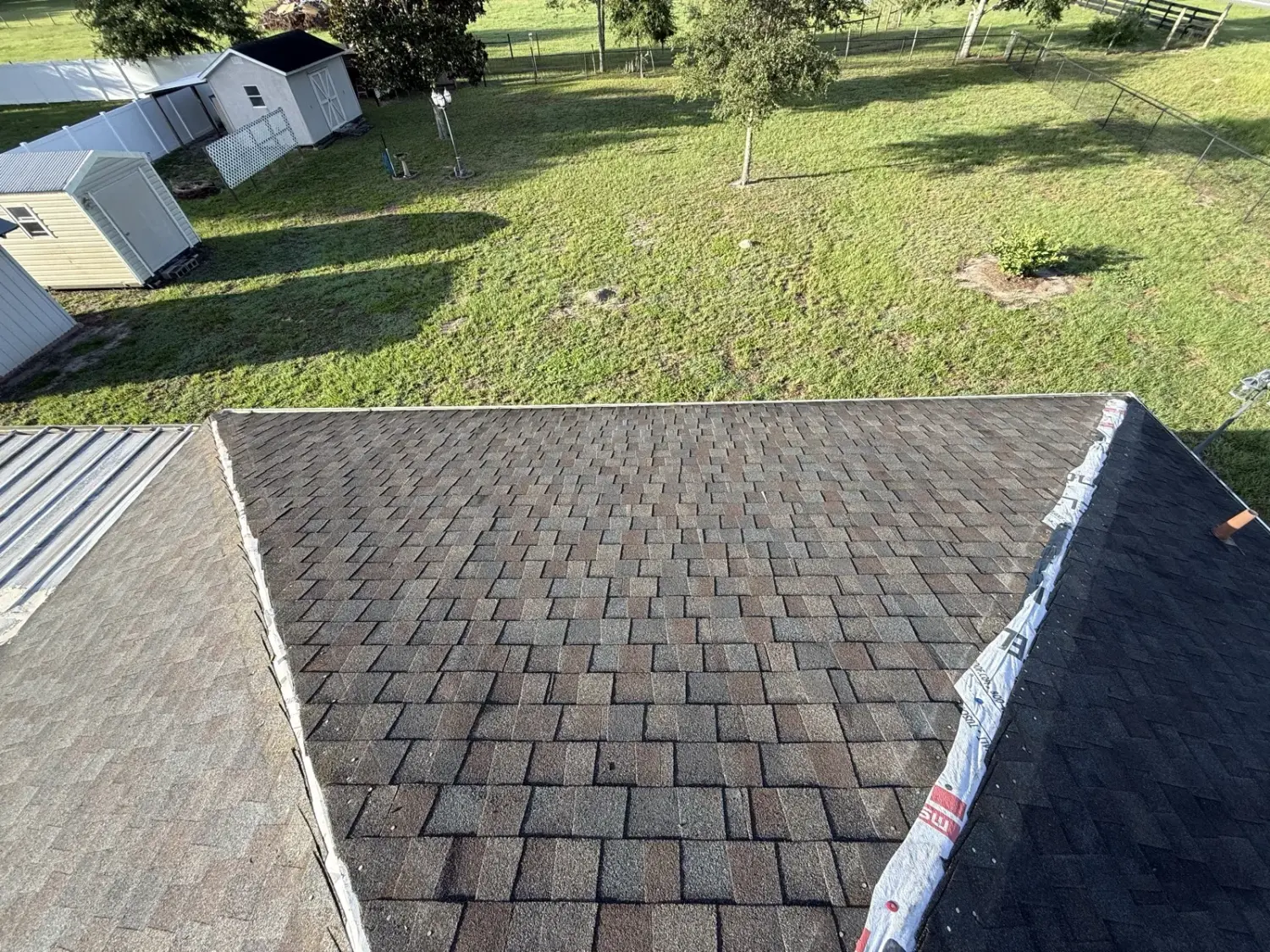
Roof repairs for a Villages roof that’s old enough to act up.
Most of the roofs we repair here are fifteen to twenty years old and failing in three or four predictable places. We find which one it is, fix the cause, and match the patch so it does not announce itself from the street.
A Villages roof rarely fails all over. It fails in one spot and hides it for a year.
Whole neighborhoods here went on at the same time, which means whole neighborhoods age at the same time. The homes around Spanish Springs are into their third decade. The Sumter Landing build-out is well past twenty. Brownwood and the villages south of it are hitting the fifteen-year mark now, which is right when the small stuff starts letting go. We see the same short list of failures on street after street, and that familiarity is what makes a repair here fast instead of exploratory.
Pipe boots are first. The rubber collar around your plumbing vents takes Florida sun with nothing shading it, and it dries out, splits along the top, and lets water straight down the pipe into the attic. Ridge caps are second. A summer cell comes through with a hard gust ahead of it, lifts a run of caps at the peak, and drops them back down looking almost fine. Then come nail pops, where fasteners work up through the shingle as the deck moves through hot days and cool nights, and each raised head becomes a small hole waiting on the next storm.
None of that needs a new roof. All of it needs somebody willing to get up there and look properly instead of quoting a replacement from the driveway.

The usual suspects
What actually breaks on Villages roofs.
Every repair gets matched to the material, the age of the roof and the real cause. These are the calls that come in week after week.
- Cracked pipe boots. Sun-rotted collars around plumbing vents, the leak we find most often and the cheapest one to have caught early.
- Lifted ridge caps. Blow-offs and loosened caps along the peak after an afternoon cell, resealed or replaced along the whole affected run.
- Nail pops. Fasteners backing up through the shingle as the deck expands and contracts, reset and sealed before they let water in.
- Lanai and birdcage tie-ins. The transition where a low-slope section meets the main roof, rebuilt with proper flashing instead of a bead of caulk.
- Low-slope sections. Modified bitumen and membrane over lanais and additions, patched at the seams and corrected where water sits too long.
- Valley and skylight flashing. Metal that has pulled or corroded where two slopes meet, which is where most long-running leaks begin.
- Wind and storm damage. Documented with photos for your records and any claim, then repaired to the same wind spec the rest of the roof was built to.
Why a small leak here travels so far.
Homes in The Villages are framed on engineered trusses, and a truss roof gives water a highway. Rain that slips past a split boot at the peak does not drip straight down into the room below it. It follows the top chord of the truss on a slight angle, sometimes fifteen or twenty feet, until it hits a low point or a bit of insulation and finally lets go. By the time you see a stain on the ceiling, you are looking at the end of the trip, not the start.
Storm season makes the arithmetic worse. From June through September a cell rolls through most afternoons, and a leak that has already found a path gets fed again every single day. Two weeks of that turns a boot replacement into wet insulation, stained drywall and a truss chord you now have to look at closely. When somebody calls us with active water, we get a tarp on it the same day and schedule the real repair behind it. Waiting is the expensive option.
Related in The Villages: roof inspections · storm damage roofing · roof replacement · metal roofing · everything we do in The Villages
Repair or replace, and how we tell you.
The other answer sounds different. When the shingles have gone brittle enough to crack under a boot, when the granules have washed into the gutters and left the mat bare, when fasteners are working loose across the whole field rather than in one patch, a repair buys you one more season and you end up paying for the work twice. In that case we say the roof is at the end of its service life, we show you the photos that led us there, and we leave the decision with you rather than pushing it.
Either way it comes to you in writing before anything starts, with the materials and the timeline on the page. That is the whole point of a written line-item quote. You should never be deciding on a roof while somebody stands in your driveway waiting for an answer.
More: the full roof repairs page · recent work in the gallery · get in touch
How it goes
How a Villages repair call runs.
You call
Active water jumps the line and gets tarped the same day.
Attic first
We trace the wet trail to the real entry point, then go up top.
Written number
Photos, line items and an honest repair-or-replace call.
We fix it
Cause corrected, matched material, damage from the water repaired.
We clean up
Magnetic sweep of the drive before the golf cart comes back out.
Patch work that respects the rulebook.
Our shop sits at 70 County Road 532C in Bushnell, about half an hour from most Sumter County addresses in The Villages, and closer to Brownwood and Sumter Landing. Close enough to come back if something needs a second look.
What Villages homeowners ask us about repairs.
My ceiling stain is nowhere near the chimney. Where is the leak?
Probably several feet uphill from the stain. Villages homes sit on engineered trusses, and water that gets past a boot or a lifted cap runs along the top chord until it finds a low spot to drip from. That is why we get in the attic with a light before we touch a shingle. The wet trail tells us where the water entered, and the stain only tells us where it got tired of traveling.
Can you match the shingle color my village requires?
That is the whole game on patch work here. We pull the color and profile off your existing roof, source the closest current equivalent, and pull the replacement caps and field shingles from the least visible slope so the patch lands where nobody drives past it. If the match will be obvious from the street, we say so before we start rather than after.
How fast can you get to The Villages from Bushnell?
Our shop is at 70 County Road 532C in Bushnell, which puts most of the Sumter County side of The Villages inside a half-hour drive, and Brownwood and Sumter Landing closer than that. Storm season runs daily here from June through September, so if water is coming in we will get a tarp on it the same day and schedule the real repair behind it.
My lanai roof is leaking where it meets the house. Is that a repair?
Usually yes. The tie-in where a low-slope lanai or birdcage section meets the main shingle roof is the single most common leak point we find in The Villages. The fix is rebuilding that transition properly with the right membrane and flashing rather than caulking the seam. We do that work in-house, so nobody has to hand you off to a second trade.
How do I know whether to repair or replace?
We tell you which one you are looking at, and we do not always say replace. If the field shingles still have life and the damage is contained, a repair is the right money. If the mat is brittle, the granules are gone and every fastener is working loose, a repair buys you a season and you will pay twice. We will say which it is in writing and let you decide.
Call it in before the next cell, Villages.
Call the owner directly or send a few details and we will set up your free roof check anywhere in The Villages. You can also reach us through the contact page.
(352) 457-4472Get my number
Fill this out and the owner will call you back, usually the same day.