
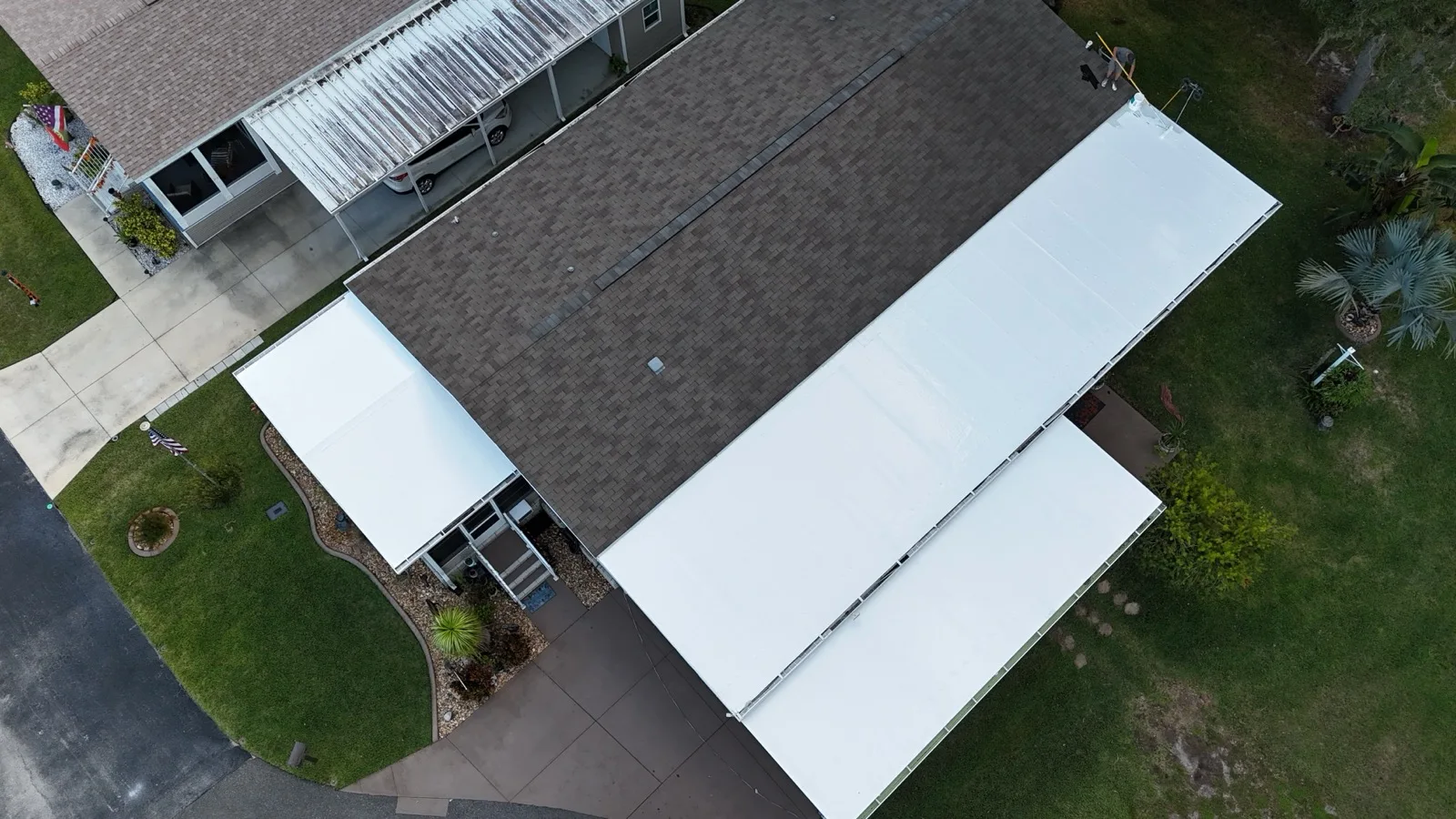
We repair the low porch, lanai and carport roofs that catch the water.
Low-slope porch, lanai and carport roofs on Villages homes, repaired with the system that suits each one. We find where the water sits, fix the seam or tie-in that let it through, and tell you plainly whether a repair is enough.
Low-slope
The flat part of the house is the part nobody climbs up to see.
Walk around most homes in The Villages and the roof you notice is the pitched shingle one. Tucked up against it there is often something much flatter: a covered porch, a lanai roof, a carport, a utility room that went on years after the house was built.
A shingle roof sheds water because it is steep enough for rain to run off before it can work into a gap. A low-slope roof cannot count on that. It keeps water out by being one continuous skin, whether that is a membrane, a cap sheet or a coating, with every seam and edge sealed. When one of those seams opens up, the water does not run past it. It sits on top and waits.
That is how a porch roof can look fine from the lawn for years while it quietly feeds water into the ceiling below. After an unusually wet October, these low sections are the first thing we ask to see on a roof check.
Most low-slope leaks we trace start at one line: where the flat roof meets the shingle roof.
That joint is a hand-off between two systems. The shingles above shed water downhill, and the low section below has to catch it without letting any slip underneath. If the membrane was never carried far enough up under the shingles, or the flashing along the joint has pulled loose or rusted through, rain runs straight into the gap and shows up as a stain somewhere inside.
The photo here, from one of our jobs, shows that joint: a granulated cap sheet on the low-slope side, tied into a brown shingle roof, with a metal flashing channel running along the seam and a pipe vent coming up through the flat section.
When the joint is sound and one penetration has failed, the fix is small and we say so. When the trouble climbs into the shingle side, our leak repair work in The Villages follows the water up the main roof.

Systems
Five materials on the truck, and the roof decides which one.
We repair every low-slope system below. None of them is right for every porch, so the choice comes from what is already up there and how the section drains.
- Modified bitumen. A granulated cap sheet laid in overlapping rolls, like the tie-in pictured above. It stands up to the occasional foot and joins neatly to a shingle roof.
- TPO. A white single-ply membrane with heat-welded seams that throws back a lot of sun, often a good match for a wider lanai or carport section.
- EPDM. A rubber membrane that stays flexible through heat and cool snaps, frequently the plainest answer on a small, simple roof.
- Coatings. A reflective coat rolled over a surface that is still solid, the same idea as the white porch and carport roofs at the top of this page.
- Manufactured home membrane. Low-slope manufactured homes get membrane systems sized to them, which is its own kind of work.
Whatever goes on has to agree with what is already there. Patching one membrane with a material it will not bond to, or coating over a soft deck, buys very little time.
How we repair low-slope roofs · Repairs on the main shingle roof · Low-slope work in the gallery
Water that stays put is working on every seam it touches.
Roofers call it ponding: water that is still sitting on a low roof long after the rain has quit and the rest of the house has dried. A thin film right after a downpour is normal. A puddle that hangs around means the section has sagged, the edge or drain has clogged, or the roof never had enough pitch to empty itself.
The repair depends on why the water is there. Sometimes it is a clogged edge, cleared in an afternoon. Sometimes a soft board has let the roof sink, and that board comes out before anything new goes over it. We check the deck before we quote, because a membrane laid over wet, spongy wood fails from underneath.
If water is already coming through a ceiling, skip the wait and call for emergency roofing in The Villages. We stop the water first and sort out the low roof once the house is dry.
From the first look up top to the last seam we seal.
A low-slope repair at a Villages home runs in this order. If the work calls for a permit, it is pulled before step three with the county that governs your address.
Look
Seams, edges, the shingle tie-in and every vent checked and photographed.
Quote
A written line-item quote naming the material, the scope and a real timeline.
Open up
Debris cleared, failed material cut back, wet or soft decking replaced.
Repair
Seams, flashing and penetrations sealed with the system that matches the roof.
Clean and walk
Scraps hauled off, a magnet run across the drive, then we walk it with you.
A porch roof you can see from the street answers to the same rulebook.
Deed compliance and architectural standards govern what goes on a roof here, and a carport or porch roof in plain view is still part of the roof. Trading a tired aluminum porch roof for a white membrane, or rolling a bright coating over one that used to be tan, changes how the house reads from the street. So before we quote a change in color or material, we hold it up against your community’s standards and gather the specs a review would want, with any permit pulled in your name.
On an aluminum porch roof, coating or membrane is usually the real decision. Sound panels with tight fasteners can take a coating that seals the seams and screw heads and keeps the look close to what is there now. Panels that are corroded through, or a roof that holds water, need a membrane or a new section, because a coating would only paint over the problem. If a storm did the damage, start with emergency tarping in The Villages and we will come back for the repair.
What Villages homeowners ask about the low roof out back.
Is a porch or carport roof really a flat roof?
Close enough. Most of them carry a slight slope, too little for shingles to shed water on their own, so they need a membrane, a cap sheet or a coating instead. We treat them as low-slope roofs, with their own materials and their own way of being repaired.
Can a coating fix a leaking low-slope roof?
Sometimes. A coating seals a surface that is still sound and reflects a lot of sun, which suits plenty of aluminum and membrane porch roofs. It will not fix a rotten deck or a failed tie-in underneath it. We check what is under the surface first and only recommend a coating when it will hold.
Why does water sit on my lanai roof after it rains?
Usually the section has settled, an edge or drain is clogged, or the roof never had enough pitch to begin with. Water that lingers wears on laps and seams and finds small openings a passing shower would miss. We find the cause first, since clearing a clog and replacing decking are very different jobs.
Will you tell me if the low roof needs replacing instead?
Yes, and in writing. We repair whenever a repair will genuinely hold. A section with soft decking across most of it, or a membrane letting go at every seam, is usually past patching. Either way you get the photos and a line-item quote before anyone starts work on it.
Does my village have to approve a flat roof repair?
It depends on your community’s standards and how visible the section is. Plenty of porch and lanai roofs sit out of sight from the street, but a change in color or material on a visible roof may need review. We check against your standards before quoting and supply the product specs a review asks for.
What should I check on a low-slope roof after heavy rain?
Look from the ground or a window and never walk on it yourself. Watch for water still sitting on the surface, new stains on the porch or lanai ceiling, and gaps along the line where the low roof meets the shingles. If you spot any of those, call and we will come take a proper look.
Let us look at the low roof nobody else looks at.
Call the owner, or leave your details and we will set up a free roof check of the porch, lanai or carport roof at your home in The Villages. You can also send a note from the contact page, browse low-slope jobs in the gallery, or read about insurance claims in The Villages if a storm started the trouble.
(352) 457-4472Low roof details
Porch, lanai, carport or a whole low-slope home, and whether water has come through yet. The owner reads each one himself.