When we sit down with an owner in Citrus Hills or Beverly Hills to talk about metal, two questions come up before any talk of color or panel style. Is it going to sound like a drum every time an afternoon storm rolls through? And is the house going to get hotter with a sheet of metal sitting on top of it in July?
Both are fair worries, and both usually come from a real memory, a barn, a carport, a shed out back. A metal roof on a house is built very differently from any of those. Here are the straight answers.
The tin shed memory, and why a house is different
Most people who worry about noise have stood in a pole barn or under a carport during a downpour. That is loud, no question. But in those buildings the panels are fastened to open framing with nothing underneath, so you are standing directly under a thin sheet of steel with air on both sides of it, and every drop lands right over your head.
On a house, the panel is the top of a stack. Under it sits a solid deck, under that the attic, under that insulation, and then your ceiling. Every one of those layers takes some of the sound before it reaches the living room.
We will not tell you a metal roof is silent. In a hard Florida downpour you can hear rain on it if you are listening for it, more of a steady patter than a drumroll. On a roof built over a solid deck with a decent attic underneath, most owners settle into it within a few storms and stop thinking about it.
The rooms that do hear more are the ones with less between you and the panel, which brings us to the parts of a metal install people never see.
What sits between the panel and your bedroom
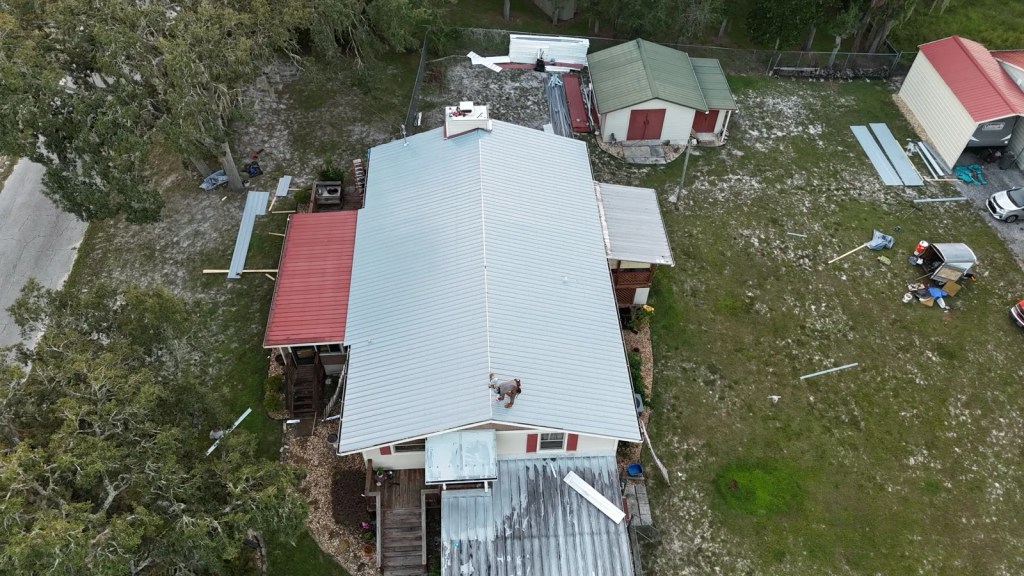
On most of our metal jobs the old roof comes off down to the deck. Any soft sheets get replaced, then a foil radiant barrier goes across the deck, and wood purlins get fastened in rows over it. The panels screw into those purlins, not straight onto the deck.
Those layers matter for sound. The deck is solid wood, which deadens vibration. The purlins hold the panel up off the deck, and that small gap breaks the direct path from metal to wood. Blown or batt insulation in the attic floor does the rest.
Where people do hear more rain is in rooms with a vaulted ceiling tight to the roof, or a porch or lanai roof where the underside of the panel is open to the air. If your house has either, tell us at the roof check. There are ways to add more under those sections, and we would rather plan for it than have you surprised by the first storm.
Heat, the attic and the color of the panel
Metal in the sun gets hot to the touch, which is where the heat worry comes from. What matters for the house is how much of that heat travels down into the attic, and a well-built metal roof sends less down than people assume.
Metal reflects a good share of sunlight instead of soaking it up, especially in lighter colors and with reflective finishes. It also cools off fast once the sun drops, where shingles hold heat into the evening. The radiant barrier under the purlins turns back much of what does get through, and the air space the purlins create helps carry heat away from the deck.
The attic still has to breathe. Intake at the eaves and exhaust at the ridge keep hot air moving out. A metal roof over a stuffy, poorly vented attic will not perform the way it should, so we check ventilation and correct it as part of the job. While we are up there we also look at the attic insulation. In a house that has stood a few decades it has often settled thin in spots, and topping it up helps with both the heat and the rain noise, whatever roof ends up on top. If you are comparing metal with a new shingle roof on the same house, our Citrus County shingle page lays out that side.
Salt air out toward Crystal River
Inland, a metal roof has an easy life. Closer to the Gulf, around Crystal River and Homosassa, salt-touched air is harder on exposed fasteners, cut edges, trim and bargain finishes. That does not rule metal out. It changes what goes on.
Out that way we spec marine-appropriate coatings on the panels and trim, and fastener systems built to hold up in coastal air. Every screw gets a sealing washer driven to the right depth, because an overdriven washer cracks and an underdriven one never seals, and in salt air either one becomes a rust point sooner.
Standing-seam panels are often the first suggestion near the coast, since their fasteners are hidden under the seam instead of sitting in the weather. Ultra-rib and 5V-crimp panels with exposed fasteners can still be the right answer on many homes, and we explain which we would use on yours. The Citrus County metal roofing page lists all three profiles we install.
Picking a profile for a Citrus County house
We install standing-seam, ultra-rib and 5V-crimp in-house, and each has its place. Standing-seam has clean vertical lines and concealed fasteners, which is why it leads the conversation in Citrus Hills, where the community allows metal and the homes justify it. Ultra-rib is a sturdy exposed-fastener panel that suits many ranch homes well. 5V-crimp has a classic old-Florida look that fits some houses around Inverness and Floral City.
Color matters too, for looks and for heat. We bring samples, and we will tell you honestly how each one holds up in full sun year after year.
Whatever you choose, the permit is filed with the Citrus County Building Division, the roof goes on to current wind code, and the job carries our 10-year workmanship warranty in writing.
Metal questions from homeowners
Will I hear acorns and branches hitting the roof?
Something heavy landing will make a noise, the same as it would on shingles, just a sharper one. Small debris and leaves are barely noticeable through the deck and insulation. If you have big oaks hanging over the house, trimming them back helps any roof, and it keeps limbs from denting panels during a storm.
Is the lanai going to be louder?
It can be, if the lanai or porch roof is open underneath with no ceiling. In that case you are close to the bare panel, much like a carport. A finished ceiling under the porch roof quiets it a great deal. We can talk through that option when we tie the porch into the new roof.
Does a metal roof draw lightning to the house?
No. Lightning goes for the tallest object around, not for the material, and a metal roof does not change your odds of a strike. If a strike does happen, metal will not catch fire the way other roofing can. It is one of the most common myths we hear at the kitchen table.
Hear it for yourself
The best answer to the noise question is standing inside a house with a metal roof during a storm, and we are happy to talk you through what to expect on yours.
Talk it over with the owner at (352) 457-4472, or use the contact page to set up a free roof check. Metal roofs we have finished are in the gallery, and everything else we do across the county is on our Citrus County page.